
Across communities, project teams often encounter the same frustrating reality: the loudest voices in a conversation are not always the most representative of public opinion. When a project is announced, opposition frequently mobilizes first. Those who have concerns or objections are often highly motivated to attend meetings, organize online, and make their views known. Their […]

Featured Blog

Transparency Builds Trust: What We Can Learn from This AI Startup’s Candor
by: Sadie Jess, KAOH Media
The pressure is on and rising at the individual and enterprise scale alike to incorporate AI-enabled tools and increase efficiency at lightning speed. For many of us working in renewables, this wave of innovation has brought with it questions about these tools’ environmental costs, which are reported to be high.
One way to get our heads around the scale of AI’s footprint to start solving the problem? AI companies can build public trust and demonstrate their commitment to solutions by voluntarily sharing comprehensive environmental audits. In other words, they can follow French startup Mistral AI’s lead.
“Without more transparency, it will be impossible for public institutions, enterprises, and even users to compare models, take informed purchasing decisions, fill enterprises' extra-financial obligations or reduce the impacts associated with their use of AI.” This summer, Mistral published a first-of-its-kind, peer-reviewed comprehensive life cycle environmental audit of its large language model (LLM), Mistral Large 2. The report breaks down the LLM’s lifecycle step by step; analyzes its environmental impact proportionally by stage; and discloses its overall carbon, water, and other material depletion figures.
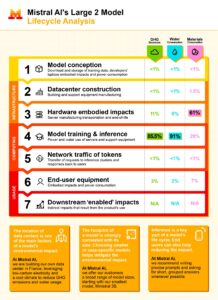
- Source: Mistral AI
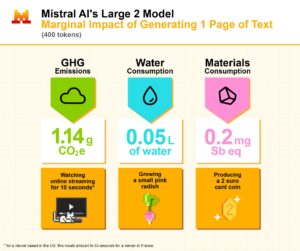
- Source: Mistral AI
This audit is the first of its kind due to its comprehensiveness and rigor. In their press release, the Mistral team writes, “Without more transparency, it will be impossible for public institutions, enterprises, and even users to compare models, take informed purchasing decisions, fill enterprises' extra-financial obligations or reduce the impacts associated with their use of AI.”
There are four bite-sized takeaways from the Mistral report we can take with us:
- Model training is the most energy and water intensive stage of an LLM’s life cycle – and it’s where renewable energy and water conservation efforts are best focused
- It matters greatly where data centers are placed (e.g. near wind, solar, and battery storage vs conventional fuel centers)
- Smaller models are less resource intensive than larger ones
- Transparency fosters trust & sparks solutions
If you’re building American energy, we can help you build trust. Let’s connect: calendly.com/wewinprojects
Recent Blogs

We align business goals
with social goals.
with social goals.