2025 will be remembered as the year of the data center, with an estimated 200 new projects offering a growing market for clean energy. Though many Americans know relatively little about data centers, they have stirred up significant opposition from people of all walks of life.
This backlash is making an impact: 25 data center projects were canceled last year and nearly 100 projects faced at least some form of opposition, according to Heatmap Pro data. At least 60 municipalities have enacted bans or moratoria on them, and many states are seeing calls for stricter regulations.
This kind of controversy is probably a familiar story to most renewable energy developers. However, by analyzing the parallels between data center and renewable project opposition, developers can glean new takeaways to support their solar, wind, and BESS projects on the path to permitting success.
Let’s take a closer look at these similarities:
Data centers face opposition on both sides of the aisle.
Unlike the renewable energy backlash, which generates more right-wing pushback, liberals and conservatives alike are mobilizing against data center development.
Michigan’s Democratic Governor Gretchen Whitmer has become the target of strong criticism for her administration’s support for data centers, leading a state public service commission that has been accused of bulldozing local objections. This has led to GOP rivals using data center opposition as a key campaign promise.
However, the Trump Administration is trying to push data center growth despite the increasing frustrations from within the Republican base.
In Georgia, a state long dominated by Republicans in statewide utility regulation, voter anger over data centers helped Democrats score their first statewide Public Service Commission victories in nearly twenty years, driven by concerns about power costs and resource consumption.
Impacts to the environment and electric bills matter.
Data center growth is under scrutiny from opponents and environmental groups alike, with concerns about unconstrained data center growth sticking residents with soaring energy bills and the consequences of environmental degradation. Those against renewable power have levied similar accusations against clean energy projects for years.
However, the impacts of data centers – exemplified by personal wells dry up due to data centers’ water usage in Pennsylvania and an Amazon data center’s pollution of the Lower Umatilla Basin aquifer in Oregon – contrast sharply with the oft-repeated benefits of renewable energy development, including grid stabilization and a healthier planet.
Out-of-town developers are viewed with suspicion.
The stereotype of renewable energy being an elite-driven ideological exercise is similar to the association of data centers with billionaires, Big Tech, and the increasingly controversial AI and surveillance programs that impact Americans’ daily lives much more than clean energy production.
Opponents decry renewable energy developers as shadowy interests with no regard to the communities they develop in, but the average American can’t name any of these developers. However, Microsoft, Meta, and Google are household, and few have positive associations with the companies.
Renewable energy opponents use data centers to recruit new members and expand their influence.
Once communities mobilize against a data center, some extend that organizing to contest associated transmission lines or renewable projects, broadening into a single movement against “advanced tech” land uses.
This cross-pollination follows (real or imaginary) practical concerns that link both types of projects, including noise, impacts to soil and water, and various claims about human and animal safety. While the backlash against solar, wind and BESS have typically focused on agricultural land, data centers being built in suburban areas bring these familiar objections to new audiences.
A notable example is the nationwide Facebook group Stop Solar-Wind-BESS-Carbon Capture Scams, which is one of the most active opposition groups with multiple posts per day and over 9,600 members. There has been a marked increase in data center-related content in the group since summer 2025, with over 20 posts on the topic in December alone. These typically consist of anti-data center “victories” across the country, describing the problems with data center development, and objections to the centers’ energy demands – including renewable energy purchasing.
Renewables and data centers can leave host communities feeling like they have little control.
With many states and the federal government offering new incentives for their development and some siting decisions being taken away from host communities, typical “NIMBY” sentiments are developing into organized opposition movements and legislative action.
Data center opponents are inflaming tensions between local and statewide siting authorities, including in suburban areas where these conflicts are historically uncommon. States with a central permitting process for data centers may be more likely to see large-scale opposition to them, like Michigan’s pro-data center public service commission. Siting authority is not the only catalyst for this resentment; In Pennsylvania, state lawmakers’ support of tax subsidies and other benefits packages for data centers in the form of tax subsidies provoked backlash from host communities.
While these comparisons seem gloomy, project developers can take meaningful action to improve public perception – regardless of a project’s data center affiliation:
- Recognize that the growth of data centers has had some tangible negatives for host communities and mitigate these impacts as much as possible. Renewable projects can offer solutions to these pain points by providing affordable power and an avenue to protect local ecosystems. Working with local environmental groups may identify additional spaces for improvement.
- Make development conversations about communities, not about the companies that will be using them. No one cares about Amazon expanding its AI capacity, but many will care about their town expanding its tax base and employment opportunities.
- Cultivate supporters who can speak in favor of developments purely on the grounds of community benefits. Local advocates can earn significantly more trust among key stakeholders, decision makers, and neighbors.
- Maximize and emphasize their unobtrusiveness. Many renewable energy projects and data centers can be screened with vegetation, and noise and environmental complaints can be mitigated with proactive agreements limiting these impacts.
At the local, state, and federal level, data centers will continue to dominate debates about land use and technology for years to come. But when a project’s publicity is in capable hands, developers and host communities alike will reap the rewards. KAOH’s collaboration with Fieldwise Civic Engagement can help you identify and overcome local opposition through our network of dedicated advocates – drop us a line to learn how we can help!
The pressure is on and rising at the individual and enterprise scale alike to incorporate AI-enabled tools and increase efficiency at lightning speed. For many of us working in renewables, this wave of innovation has brought with it questions about these tools’ environmental costs, which are reported to be high.
One way to get our heads around the scale of AI’s footprint to start solving the problem? AI companies can build public trust and demonstrate their commitment to solutions by voluntarily sharing comprehensive environmental audits. In other words, they can follow French startup Mistral AI’s lead.
“Without more transparency, it will be impossible for public institutions, enterprises, and even users to compare models, take informed purchasing decisions, fill enterprises' extra-financial obligations or reduce the impacts associated with their use of AI.”
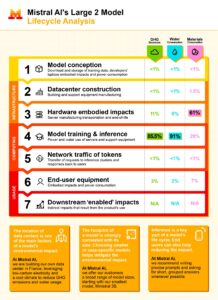
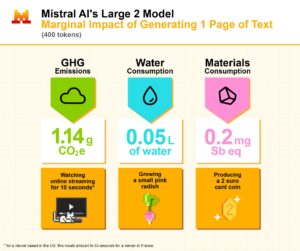
This summer, Mistral published a first-of-its-kind, peer-reviewed comprehensive life cycle environmental audit of its large language model (LLM), Mistral Large 2. The report breaks down the LLM’s lifecycle step by step; analyzes its environmental impact proportionally by stage; and discloses its overall carbon, water, and other material depletion figures.
- Source: Mistral AI
- Source: Mistral AI
This audit is the first of its kind due to its comprehensiveness and rigor. In their press release, the Mistral team writes, “Without more transparency, it will be impossible for public institutions, enterprises, and even users to compare models, take informed purchasing decisions, fill enterprises' extra-financial obligations or reduce the impacts associated with their use of AI.”
There are four bite-sized takeaways from the Mistral report we can take with us:
- Model training is the most energy and water intensive stage of an LLM’s life cycle – and it’s where renewable energy and water conservation efforts are best focused
- It matters greatly where data centers are placed (e.g. near wind, solar, and battery storage vs conventional fuel centers)
- Smaller models are less resource intensive than larger ones
- Transparency fosters trust & sparks solutions
If you’re building American energy, we can help you build trust. Let’s connect: calendly.com/wewinprojects
We’re constantly told that artificial intelligence can solve a growing host of needs: organizing your emails for you, writing content, or even open-source intelligence research for your project. Running this kind of competitive intelligence may seem like an ideal use of AI tool, such as a large language model (LLM). After all, it’s just gathering online sources, right? In reality, even the most modern AI tools fail can't match KAOH's CI analysts. Let’s look at a few AI use cases and issues that show how vital the personal touch is:
-
Stakeholder research
Let's say you need a list of board or planning commission members for a small township in rural America. While this could easily be a question for ChatGPT or a more research-focused application, many of these tools rely on municipal websites that are rarely updated, frequently sharing outdated information. Furthermore, these tools often confuse municipalities across states (Champaign, Ohio vs. Champaign, Illinois) and confuse counties with municipalities (Bay City, Michigan vs. Bay County, Michigan).
-
Monitoring community reactions
AI-powered source aggregators may have success in picking up major stories about a project, but they struggle to access vital social media chatter beyond the headlines. Social media channels often feature content that cannot be accessed without a human analyst’s know-how. Nextdoor neighborhoods, LinkedIn posts and most Twitter or Instagram content remains almost entirely inaccessible to AI-powered source aggregators, along with a significant amount of hard-to-find Facebook content.
-
Analyzing sentiment and reactions
CI tools using AI often advertise an ability to accurately monitor sentiment in the sources they find, but we have found that these tools rarely capture a mention’s true meaning and instead rely on a small number of trigger words to assign a positive or negative value. For example, a Facebook post that reads “I would be so happy if the wind turbine developers left town” may be flagged as positive, since the terms “happy” and “wind turbine” appear in close proximity. Many sentiments are more complex than what a tool can identify, and more nuanced viewpoints get overlooked by using a linear scale. Some AI-powered programs claim that they can create actionable analyses, such as community engagement plans, out of a set of media mentions. If available, this analysis might offer a vague overview of reactions to a project without creating a coherent, project-specific plan to address these concerns.
-
Telling you what you want to hear
Standard AI tools might focus on creating output that is satisfying to the user rather than output that is accurate. If you ask an LLM for fifty words about professional ice skating in Tahiti, it will most likely answer with generic statements about the sport’s global popularity instead of telling you that a small South Pacific nation has never hosted an ice-skating competition. We see the same type of output when asking an AI tool an open-ended question about stakeholder opinions, popular perceptions or permitting outlook for a project that has not yet been announced.
How to Change Hearts and Minds in the Age of Digital Advocacy
WRITTEN BY: Steven Marciniak | Founder and CEO | policyengage.com
Do you know what techniques political insiders use to win you over? No, we’re not talking about the campaign tactics Trump and Biden used to get you to the polls. We’re referring to under-the-radar grassroots strategies, such as those used to restart production on a certain chemotherapy medication for children.
In recent years, grassroots campaign leaders have become just as sophisticated as their electoral advocacy peers — who focus on specific political candidates or ballot measures — at getting you to share that Facebook post to prevent animal cruelty.
But what exactly is grassroots advocacy? In short, a grassroots advocacy campaign is an organized and sustained effort to mobilize individuals to influence — perhaps enthusiastically support, vehemently oppose, or just neutralize — a specific policy or issue. Nonprofits often leverage grassroots advocacy tactics, but they can be used by anybody.
We asked our community of industry experts to open their playbooks, revealing strategies that grassroots campaign leaders use to sway you every day, even if it’s just to make Baby Yoda an official emoji.
Their techniques are extensively researched, highly nuanced, and consistently effective. You may have already said “yes” to more than a few of them. Let’s take a look at the 14 grassroots campaign strategies that get results.

Flood
The “Flood” campaign curates advocate messages over a specific period of time, then delivers them all at once. Often combined with digital advertising, the Flood campaign is designed to create awareness and demonstrate a substantial number of constituents who are unified and mobilized for a specific cause at a given time.

One-Two Punch
Believed to have its origins in boxing, the “One-Two Punch” is a quick combination akin to a jab and uppercut. Sports analogies aside, in advocacy, this can be implemented by releasing several campaigns in rapid succession to overwhelm the target. By combining an email campaign with a follow-up call campaign shortly thereafter, the One-Two Punch can have an impact.

Petition-Backed
The “Petition-Backed” campaign has several moving parts and may include grasstops. First, create a petition where you gather a significant number of signatures around an issue, position, or policy. Then, with grasstops and/or advocate outreach, make your targets aware of the surmounting mass appeal of your campaign. Successful Petition-Backed campaigns generate peer pressure, group identification, FOMO (“Fear of Missing Out”), communal fellowship, and viral reach on the advocate side, while demonstrating broad support or opposition on the target side.

Tweet Storm
Successful “Tweet Storm” campaigns generate peer pressure, group identification, FOMO (“Fear of Missing Out”), communal fellowship, and viral reach on the advocate side, while demonstrating broad support or opposition on the target side. This campaign is similar in process to the Petition-Backed campaign but uses social media — in this case, Twitter — as the vehicle to ignite activity and garner mass appeal. Then, with grasstops and/or advocate outreach, make your targets aware of the surmounting mass appeal of your campaign. As an added benefit, this strategy takes your campaign public. For extra impact, add elected officials to the tweets and hashtags.

Thank and Spank
While not new, “Thank and Spank” works well when combined with other campaign techniques. This campaign essentially thanks those targets who are on your side (co-sponsored a bill, voted in favor of the organization, etc.) and spanks those who are not by publicly shaming and drawing attention to their actions or lack thereof. This campaign approach can easily be broken out by chamber, co-sponsors, or votes to focus your efforts. More often than not, those being “thanked” in the campaign align with the organization while those getting “spanked” do not.

Media Blitz
A “Media Blitz” can play a role in any advocacy campaign. In this strategy, the media are included as targets of the campaign. After researching and determining which media outlets (local news, blogs, etc.) are covering or likely to cover the issue, add them to the mix of targets to create additional pressure on elected officials. Writing letters to the editors combined with well-crafted emails and tweets can create just the media spectacle your campaign needs.

Slow Drip
“Slow Drip” alludes to a gradual demise resulting from numerous minor problems that add up over time. This can be an effective strategy if you have a longer period, perhaps several months, to manage the campaign. Often coupled with digital advertising to attract and assemble additional advocates, the Slow Drip campaign delivers a barrage of constituent messages at predetermined intervals to wear down the target until they are no longer a threat.

Shock and Awe
When facing an unwanted and looming outcome (such as a floor or committee vote), the “Shock and Awe” campaign can be effective in thwarting a particular legislative proposal or at least delaying it to buy time to battle another day. Getting its name from military strategy, Shock and Awe has the most impact when the campaign has highly motivated advocates. Frequently combined with a digital advertising campaign to amass supporters, Shock and Awe utilizes all modes of contact targeting — including in-person meetings, emails, calls, text messaging, faxes, and social media — hitting the target hard from all sides simultaneously.

Carrot and Stick
The metaphor “Carrot and Stick” refers to a motivational technique that combines reward and punishment to encourage certain outcomes. When used in an advocacy campaign, the proponents emphasize the positive outcomes of accommodating their position while outlining the fallout if the target does not acquiesce — thereby incentivizing a positive outcome.

Mounting Pressure
“Mounting Pressure” is a tactic frequently used in party politics and elections, but it can also be used in advocacy campaigns when there is growing disdain for a particular position embraced by legislative leadership. For example, advocates can target committee members and reveal deficiencies of the committee chairman’s proposal. This is to generate peer pressure on the chairman to rescind the proposal before the committee. Depending on time constraints, other advocacy tools could be used including email blasts and text message campaigns. If behind-the-scenes pressure is needed, a grasstops operation may be mobilized.

Dual-Track
The “Dual-Track” campaign might require enhanced coordination, but the impact can be impressive and rewarding. When the opportunity presents itself, several advocacy groups coordinate to launch simultaneous attacks on the same target — but from different viewpoints — and in the process, stretch the target’s resources and render them less effective. Depending on the time needed to accomplish the goal, various advocacy tools can be used from targeted emails to text messaging. A grasstops effort may be mobilized if behind-the-scenes pressure is needed.

Odd Man Out
The “Odd Man Out” campaign is designed to highlight a particular legislator’s position as not aligned with others or the overall legislative body. By directing advocacy activity towards acknowledging those who are aligned while mentioning those legislators who are not, the campaign places peer pressure in hopes of forcing a concession. Depending on the time frame needed to reach the goal, a number of advocacy tools can be used from emails to text messages. If behind-the-scenes pressure is needed, a grasstops operation may be mobilized.

Between a Rock and a Hard Place
The common expression “Between a Rock and a Hard Place” — when you’re presented with two undesirable or unacceptable choices — describes when two or more advocacy campaigns are launched simultaneously, leaving the target with no political cover. The first campaign criticizes the target’s current position while the second exposes the target’s previous position as counter to its current one. By exposing the target as a flip-flopper, you have them right where you want them: between a rock and a hard place.

Strange Bedfellows
“Strange Bedfellows” is when two or more groups with extremely different ideologies coalesce their campaigns around the same issue. This kind of campaign can initially confuse the target and stretch their resources so much that they lose effectiveness. Once again, depending on the time needed to accomplish the goal, various advocacy tools can be used from targeted emails to text messaging. If behind-the-scenes pressure is needed, grasstops efforts may be mobilized.
Grassroots advocacy leaders use creative techniques to win you over every day. And while they differ on many accounts, the most successful campaigns all have one thing in common: a meticulous game plan. We hope these 14 grassroots strategies guide you in creating even more compelling campaigns that get results — and change hearts and minds along the way.
Steven Marciniak is the Founder and CEO of PolicyEngage a software company that helps public affairs professionals track legislation and regulations, engage advocates and donors, and monitor media.